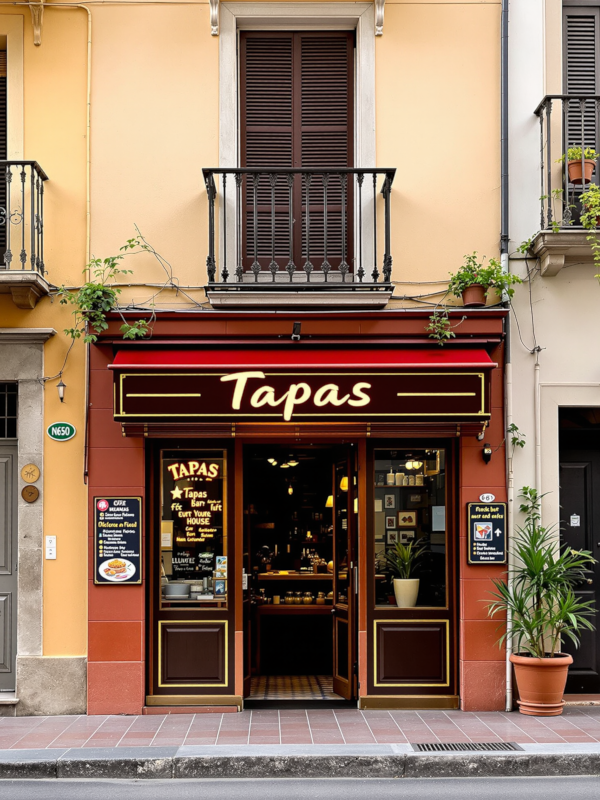

Tapas in València
A phone rang. It wasn’t mine.
Someone picked up.
“I’m sorry, but we don’t take table reservations,” a muffled woman’s voice said.
“No,” she replied, listening for a moment longer. Then: “No. Look, this is a detective agency!”
I blinked. Around me, the furniture of an office, filing cabinets, certificates on the wall, a plastic parlour palm in the corner, grey with dust. In front of me, a desk with a phone, a laptop, and my feet. On the other side, two chairs upholstered in black faux leather, waiting for clients who probably had more problems than money.
My first glance went to my wrist. A gold watch, looking too real to be real, covered my tattoo. I slid it off and found two lines underneath.
“Miray must be here too,” I muttered, grinning to myself.
I swung my legs off the desk. The backrest of my office chair squeaked in protest as I tried to sit up straight. Apparently, it liked the reclined position just as much as I did.
In front of me, a desk pad sprawled across the surface, also in black faux leather. Next to it, a box of pens, one of business cards, and a small box.
I pulled a business card from the stack and read it. Private Detective was printed there, with 17 Plaça de l’Espart, València as the address. Above it, in bold letters, was my name.
“Dian de las Tapas,” I read aloud.
I made a face. “That doesn’t sound like a name. More like a starter.”
I checked out the box. Turrón de Jijona was printed on it in red letters. I opened it and found light brown blocks cut into long strips. I popped one into my mouth. It tasted sticky, nutty, sweet like a bath in molasses.
There was a knock at the door. A woman walked in. Maybe thirty, petite, round face, shoulder-length hazel-brown hair, glasses perched on her nose that made her look like an owl. No idea who she was. Not Miray, though.
“The appointment’s here,” she said matter-of-factly, gesturing towards a waiting area on the other side of the door.
“Thanks, Señora,” I said. The turrón clung to my lips like a cigar.
She froze, then slowly turned to face me.
“Señora?” she repeated sharply. “Are we back to Señora Montserrat?”
She crossed her arms. “What happened to Clara? Or your Torbellina?”
I cleared my throat. “Sorry, Clara. Send the appointment in.”
My appointment. The entrance of the femme fatale. Had to be Miray, I thought, grinning widely.
I shifted the turrón to the other side of my mouth, wiped my sticky fingers on the chair cushion, propped my feet up, and stared out of the window like I owned the place. Across the way, on the opposite balcony, a bloke in white ribbed briefs was hanging up his laundry.
The door opened. I heard footsteps.
“Hey there, doll,” I purred in a masculine voice that would’ve made Humphrey Bogart jealous. “Long time no see.”
A cough.
“Do we know each other?” a deep male voice rumbled. “Or why are you calling me doll?”
Startled, I spun around and found myself face-to-face with a man, about forty, in a business suit, hat, briefcase, his face shaved smoother than an ice rink. My mouth fell open, the turrón clinging to my bottom lip.
I yanked my feet off the windowsill and jerked upright. The backrest let out an ominous squeak.
“Forgive me, señor…” I stammered, gesturing to a chair in front of me.
He sat down, folded his sunglasses, and placed them carefully on the desk.
“Gonzalo Herrera Pardo,” he introduced himself.
Then he looked around, as if to make sure we were alone.
He leant in slightly and spoke quietly. “I’ve come to you on a sensitive matter, Señor de las Tapas. Can I count on your absolute discretion?”
I nodded eagerly. “Absolutely, Señor Herrera. These lips are sealed like the tomb of Cheops.”
I zipped an imaginary zip across my mouth.
Herrera didn’t even crack a smile.
I sighed quietly to myself and gave my client a serious look. “What brings you here, Señor Herrera?”
His fingers tapped briefly on the armrest. Then he nodded.
“I’m with the Tropas Ofensivas Nacionales de Tácticas Ocultas, a Secret Service agency under the Ministerio de Defensa.”
He placed his bag on the desk.
“Our informant in Turkey wants to get a briefcase with important documents to us. Very sensitive documents, the defence capabilities of our country are at stake. We don’t know if an enemy intelligence agency is already onto him. That’s why we can’t waste any time getting the briefcase to us.”
He opened his bag, pulled out two paper strips, and tossed them onto my desk pad.
“These are plane tickets to Istanbul and back. You’re flying out tonight and meeting our contact at Sky Coffee in the airport’s main terminal. He’ll have a black diplomatic briefcase with him. You’ll say the passphrase, and he’ll hand it over.”
“What’s the passphrase?” I asked.
He nodded. “You’ll ask: ‘Do you floss?’ He’ll answer: ‘Only when I eat onions.’ Then you say: ‘The green one tastes refreshing, like menthol.’”
“Do you floss,” I repeated. “Kind of a weird passphrase.”
“That’s the whole point, Señor Tapas, so the enemy can’t just guess it!” Herrera snapped. “Once you have the briefcase, don’t let it out of your sight for a second. Take the next flight back to València. We’ll meet here in your office tomorrow at noon. Got it?”
I nodded.
He gave me a serious look. A firm, cold stare. The kind of bloke who’d have to look up fun in the dictionary.
“Señor de las Tapas, I shouldn’t have to tell you that the nation’s security depends on your success. You can’t afford even the smallest mistake!”
“I’m flattered, Señor Herrera.” I took the turrón out of my mouth, looked around for a plate, didn’t find one, and set it on the box. “But why not send one of your own guys?”
Herrera glanced around the office again before answering. “There was a breach. Hackers got hold of a list of our agents. If we pick up the briefcase ourselves, we’d be recognised and intercepted at the airport. We need an unknown face for this transaction. What’s more natural than hiring a detective known for his reliability and loyalty?”
I popped the turrón back into my mouth. “And the payment?”
“Oh, right!”
He opened his briefcase again, took out an envelope, and placed it next to the plane tickets. “We pay well. You’ll find two hundred euros in there for your initial expenses. If you succeed, ten thousand euros await you. A nice hourly rate, considering you fly out tonight and are back by noon tomorrow, isn’t it?”
I peeked into the envelope and found four fifty-euro notes.
“So, you’re taking the job, Señor Tapas?”
“Absolutely!” I stood up and held out my hand. “You can count on me, Señor Herrera.”
He shook it, and I walked him to the door, where he grabbed his hat from the coat rack and put it on. He gave me one last look, nodded silently at Clara, and left.
Clara watched him go like she could see through walls.
“What did that guy want?” she muttered.
“A new job, Clara. I’m flying to Istanbul today and will be back by noon tomorrow.”
A smile spread across her face.
“I hope he pays well,” she said. “We could really use the money.”
She pointed to a door next to her desk. Well hidden, closed, barely visible in the dark corner.
“Should I pack for you? You won’t need much for one night.”
“I live here?” I blurted out.
Clara gave me a worried look. “Unless you’ve secretly got another place to stay,” she said slowly. “You were trying to save on rent.”
I laughed awkwardly. “This case is throwing me off, Clara.”
Her worried expression only slowly gave way to a faint smile.
She glanced to the side, her eyes landing on a bundle of letters.
“Oh, right,” she said, handing them to me. “The postman left Toño’s post here again. Can you take it down to him while I pack for you?”
I nodded. Who this Toño bloke was, I didn’t dare ask any more. I decided to figure it out myself. After all, I was a detective.
A narrow staircase led down to the first floor and straight to a front door. Grey wood, paint peeling off. Above the door, a dim transom window with the house number backward. No door to Toño’s place in sight.
I stepped outside and found myself in a narrow alley. Old buildings in warm earth tones leaned close together, casting just enough shade to make the scorching summer heat bearable. A light breeze drifted through the street. It didn’t bring any freshness, just the smell of hot stone, coffee, and something grilled.
Right next to the front door, I spotted the entrance to a small restaurant. Under an awning, two empty tables sat on the pavement, waiting for customers.
Above the entrance hung a wooden sign. In red letters, just one word: Tapas.
I walked in. Behind the bar stood a man, black hair, well-groomed moustache. His clothes, neither too fancy nor too casual, told me he owned the place. In his left hand, he held a chalkboard; with his right, he was writing the day’s specials on it.
“Toño?” I asked cautiously.
He looked up, the corners of his mouth curling into a smile, and set the board aside.
“Dian,” he called, waving me over. “What brings you by?”
I waved the bundle of letters. “Got something for you!”
“My post? Not again!”
He flipped through the envelopes, skimming the return addresses.
“This can’t keep happening, Dian,” he muttered. “A bar and a detective agency in the same building, both called Tapas. That’s one too many. You’ll have to shut your place down.”
I laughed. “I don’t know what Clara would say about that.”
“Torbellina? She could start working for me right away.” Toño smirked. “Since you’re here, want to try a Café de Olla?”
I frowned. “What’s that?”
“It’s a recipe from Mexico I found. Let me surprise you!”
“I actually need to get to the airport.” I hesitated. “But now I’m curious.”
Toño nodded, satisfied. A minute later, a small clay cup sat in front of me, smelling intensely of cinnamon.
It was almost midnight when I cleared customs in Istanbul and wandered through the airport’s massive halls. The air carried the scent of coffee, cleaning products, and the faint hum of fluorescent lights. Exhausted travellers and busy airport staff moved through the night like they all still had somewhere to be; all except for me. The halls and long corridors felt like a maze of light and shadow, where the murmur of people mixed with the rattle of luggage trolleys.
Near one of the entrances, I found the agreed meeting spot. Sky Coffee was framed by large sliding glass windows that didn’t look like they ever closed. Most of the tables were empty, just a few figures waiting for their flight or something else.
In the back, a wide counter stretched along the wall, warm wood tones against a sky-blue backdrop. The display case was filled with sandwiches, cakes, and salads. Behind it, a cashier sat on a stool, slowly losing the battle against sleep.
At one table sat a man of Asian descent, engrossed in his work, typing away on a laptop covered in colourful stickers, a half-empty cup of coffee going cold beside him. At another table sat a young couple. Their stuffed hiking rucksacks told me they were tourists.
In one corner, I finally spotted a guy. Goatee, black suit. On his table sat half a dozen empty coffee cups and two plates with nothing left but cutlery, a crumpled serviette, and a few crumbs. Next to him stood a black briefcase. When he noticed me clocking him, he waved me over in a hurry.
I walked up and gave him a cautious smile. “Do you floss?”, I started, using the passphrase.
“Cut the crap,” he growled, annoyed. “It’s obvious you’re the one. Who else would approach me at this ungodly hour in an airport café?”
He grabbed the case, stood up, and shoved it into my arms.
“Here, take this thing already. And make sure the contents don’t get wet.”
He gave a curt nod and muttered a “Kolay gelsin!” – may it come easy to you. No smile, as if he already knew things wouldn’t go that way. Then he left the café.
I stared after him, stunned. The handover hadn’t exactly gone as planned, but whatever. I had the case in hand. That part of the job was done.
Next up: grab some food, then catch a few hours’ sleep at the airport hotel before my early flight to València tomorrow.
The job was going as smoothly as a bar of soap in the shower.
My stomach growled, but nothing in the café really appealed to me. So I nodded goodbye to the bloke behind the counter and was about to leave when he called after me.
I turned, raising an eyebrow.
“The gentleman you were just talking to… He said you’d cover his bill.”
I looked at the door the guy had just disappeared through and shook my head in disbelief. Then I paid the tab and left.
I wandered around the airport for a while until I found a place selling loaded lahmacun. Full, I headed to the hotel and booked a single room. After that, my expense advance was pretty much just a memory.
The next morning, I grabbed a quick breakfast to go and got in line at the check-in desk. Finally, it was my turn. I slid my passport and ticket across.
The woman at the desk flipped through the documents, bored.
“How many bags?” she asked.
“Just my rucksack and the case.”
She peered at me over her glasses. “Your ticket only includes one hand luggage, Mister Tapas. We’ll have to charge you for the case.”
I hadn’t even thought about that. When I left for Istanbul, I only had the rucksack Clara packed for me. Now I had an extra case that was too big to stuff into the rucksack.
“I’d really rather not let go of the case,” I grumbled.
She shot a contemptuous glance at my rucksack. “Sir, trust me, if you check that rag instead, you’ll get it back in València in pieces. Check the suitcase. It’ll be fine.”
“But the case…”
Desperate, I glanced at the bloke behind me, hoping for backup. Passengers vs. airline. Instead, he shot me an annoyed look and tapped his watch.
“Sir,” the woman at the desk said, “we’re not getting anywhere like this, and the flight’s already delayed. Either you check the case and pay for the extra bag, or you stay here. Your call. But decide now.”
I sighed and set the case on the belt. She nodded in relief, slapped a sticker on the handle, and stuck the claim stub on my ticket. My advance didn’t cover the fee. I dug into my pocket and tossed the rest of my cash after it. The case rolled off the scale and disappeared behind a curtain, like a decision you can’t take back.
With a solid hour’s delay, the plane landed in València. I cleared passport control and hurried to baggage claim. Within minutes, the belt started moving. Luckily, the airport’s guts didn’t take long to cough up the case.
I pulled it off the belt, then checked my watch. Time was really tight now. Nothing else could go wrong.
It was five past twelve when I reached the detective agency. Herrera was already there, chatting with Clara. Her worried expression melted into relief when she saw me walk through the door.
Herrera gave me a stern look. “There you are, finally,” he grumbled.
When he noticed the case in my hand, his mood improved slightly.
I waved him into my office and shut the door behind us. Then I offered him a seat, sat down across from him, popped a turrón into my mouth, and held the box out to Herrera. He just shook his head. I shrugged, closed the box, and put it away.
He pointed at the case. “I see you were successful.”
I nodded proudly. “Yeah, no problem.”
Herrera reached for the luggage, but I pulled it away.
“Let’s talk payment first.”
He shot me an irritated look. “I haven’t forgotten, Señor Tapas. You can give me the invoice. The agency will transfer the amount.”
“Transfer?” I stared at him, confused.
He let out a short, dismissive laugh. “Of course, what did you think? We’re not doing this under the table. I need an invoice, or there’s no money. Accounting’s orders.”
I nervously chewed on the turrón. What Herrera said made sense. After all, you can’t even pay for a new car in cash these days. Still, it didn’t feel right.
I caved. “Fine, I’ll have Torbellina draw up the invoice.”
“Torbellina?”
Herrera looked at me, puzzled.
“My secretary.”
“Ah,” he said, then pointed at the case. “May I now?”
Without waiting for an answer, he took it and set it on his lap. Then he started fiddling with the combination lock.
I watched him smugly. Case closed, and without Miray’s help. She’d be proud of me. That is, if we even meet before I wake up.
I took off my watch and glanced at my wrist. Two lines, still, but no green circle. I shook my hand like the tattoo had some hidden mechanism that was just stuck.
“Damn it,” Herrera cursed. “This bloody lock won’t budge.”
He pulled a solid folding knife from his inside pocket and went to work on the clasps. With a loud snap, they finally gave way and popped open. He nodded, satisfied, and put the knife away.
Then he opened the case.
The spark in his eyes vanished. His mouth turned downward. He ran his hand through the contents, first tentatively, then more frantically. A few socks spilled out the side. Finally, he turned the entire suitcase upside down and shook it. More clothes, a tube of toothpaste, and a bunch of silver shower caps scattered across the table.
Herrera dropped the case and slammed his hands on the table.
“You taking the piss, Tapas?”
He took a deep breath, looked around, and calmed down a little.
“Now we’ve got a problem, Tapas. And I hate problems,” he warned. “Where’s the real case?”
I stared at the pile of stuff on my desk. Didn’t exactly look like top-secret documents.
“I don’t get it,” I muttered. “This can’t be!”
“Can’t be?” Herrera pointed at the heap. “You see for yourself. This isn’t the right case.”
“But I did everything exactly like you said,” I protested.
He slumped into the chair. Took a deep breath. Rubbed the back of his neck. Thought for a moment.
After a while, he took one of my business cards and scribbled something on the back.
“Get me the right case. Now. When you have it, call me.”
He pressed the card into my hand. On the back was a mobile number.
“And I’m telling you, Tapas: get your ass in gear. You don’t want to find out what happens if you waste any more of my time.”
He stood up and buttoned his suit. Then he shot a quick, disapproving glance at the mess on my desk before leaving the office without another word, slamming the connecting door behind him.
I leaned back in my chair, stared out the window, and sighed. “Well, at least that explains the missing green circle,” I grumbled.
The connecting door opened again, and Clara stepped in. She gave me a worried look. Then her eyes landed on the pile of laundry spread out on the table.
“Everything okay, Dian?”
I nodded. “Just a little complaint.”
I glanced at my business card with his number on it for a moment, then tucked it away.
Clara picked up the case from the floor and started packing the stuff back in. I watched her. But my mind was racing about how to get out of the mess I was knee-deep in.
There was only one solution.
“Clara, I need your help. I have to find a woman.”
Her face lit up instantly.
“I was starting to think you’d never ask! Coincidentally, I know just the right one for you: Marta. She just broke up with her mechanic and is looking for a guy who isn’t into engines. And she loved your photo.”
I shook my head. “No, no. I’m looking for a specific woman. Around my age, attractive, platinum blonde, blue streaks, wild pixie cut, eyes like two frozen lakes…”
Clara blinked.
“Wow,” she said. “You’ve got a very specific type. Have you tried a dating service?”
“A dating service? You think?” I hesitated. “I was thinking more like a private detective.”
She shook her head like my words didn’t make sense. “So you’re hiring yourself now, or what’s the plan?”
Just then, the door flew open. Three cops stormed in, heading straight for me.
The youngest one stepped forward. He wasn’t particularly tall, but the dark blue uniform fit perfectly, his short black hair was military-neat, and his dark eyes sized me up with a mix of professionalism and determination.
“Dian de las Tapas?”
He held his badge in my face.
“Subinspector Torres. I need you to come with me to the station.”
I stared at him, shocked.
“What’s he accused of?” Clara cut in.
“He’ll find out soon enough,” Torres answered. “But I really wouldn’t want to be in your shoes, Tapas.”
The other two cops helped me out of my chair, twisted my arm behind my back, slapped on handcuffs, and stuffed me into a squad car parked outside.
About twenty minutes later, I was sitting in a cramped interrogation room that looked like it was ripped from a bad cop show, with dark grey walls, a spotlight, and a two-way mirror on the wall.
“Wait here,” Torres ordered, like I had a choice. “Someone will be in to question you shortly.”
“Don’t I get a solicitor?” I protested.
“Not my call,” Torres said calmly as he removed the handcuffs.
I resigned myself to my fate. My hands patted my pockets and found what they were looking for. I pulled out a box.
“What’s that?” Torres asked.
“Turrón,” I said curtly. I opened the box and held it out to him.
He declined. “No eating in the interrogation room!”
He shook his head and left, closing the door behind him.
I sighed. It had only been an hour since I thought I’d nailed this whole adventure. Now some spook was breathing down my neck, and I was stuck in this room instead of tracking down Miray and the real briefcase.
I stood up and walked over to the mirror. How many people were back there watching me right now? I breathed on the glass and drew a smiley face in the fog.
Torres swung the door open. He jabbed a finger at the chair, all business. Then he glanced down the hall and waved someone over.
A woman stepped inside. Inspector’s uniform, peaked cap. Underneath, platinum-blonde hair with blue streaks flashed in the light.
“Miray!” I blurted, rushing towards her. “Finally!”
I couldn’t help myself, I hugged her.
Torres stared at us, stunned. “Last guy who hugged an inspectora like that got a free night in the drunk tank,” he muttered. “You know him?”
Miray pulled away and straightened her polo shirt. “We’ve worked a few cases together. Back in the day. Another life.” She turned to Torres. “Can you give us a minute?”
He hesitated, eyeing me like I was a deranged serial killer.
“Really, Inspectora?” he asked. When Miray nodded, he shot me a squinty glare before stepping out and shutting the door behind him.
We sat down at the table. Miray pressed a finger to her lips and pointed at the mic between us. She fiddled with a switch, and the red light died.
“Now we can talk,” she said.
Good. Because I had questions.
“What’s with all this hocus-pocus, Miray?” I huffed. “If this is about the lost briefcase: it was a government job, nothing dodgy. No reason to haul me in!”
“What briefcase?” Miray gave me a sheepish smile. “I just asked Subinspector Torres to track you down and bring you here. He was supposed to pick you up, not arrest you. Guess he got the wrong end of the stick.”
She cracked open a mini bottle of water, slid it towards me, and grabbed one for herself.
“Apparently you’ve been busy,” she said. “What’s this government job? And what briefcase did you lose?”
I took a long swig, grateful, then slumped back in the chair and let out a quiet burp.
I told Miray about the detective agency. About Herrera hiring me to fetch important docs from Istanbul. How I’d apparently delivered the wrong briefcase, and now I had to track down the right one and call him.
Miray perked up. “You have his number?”
I nodded, pulled the business card from my pocket, and slapped it on the table.
She picked it up. A grin spread across her face. “Your name is Dian de las Tapas?”
“His mobile’s on the back,” I grumbled, twirling my finger.
Miray flipped the card over, glanced at it, then set it down in front of her. She closed her eyes and tapped her nose.
For a long time.
“You know what, Dian?” She looked at me. “I think you’re the first private eye I’ve ever heard spill his guts to a cop about his problems.”
She called Torres back in and asked him to run the number. He left and returned a few minutes later with a scrap of paper.
“Registered to a Señor Gonzalo Herrera Pardo,” he said.
“Got an address?”
Torres nodded. “Some little street out in Benimaclet. Should we head over?”
“I don’t mean to rain on the parade,” I cut in, “but shouldn’t we find the right suitcase first?”
“Only Señor Herrera knows what the right suitcase is.” Miray stood up and adjusted her cap. “So let’s pay him a visit and ask what he actually lost.”
Torres parked the squad car at the kerb. The street was narrow, lined with old, weathered houses whose facades looked washed-out in the afternoon sun. We got out and walked down slowly, scanning for the house number.
But we didn’t find it. Where the house should’ve been, there was just a gaping hole. A rusted construction fence surrounded the lot, behind it a wasteland of broken bricks, twisted metal, and overgrown weeds. A few dried-up plants clawed through the rubble, like they were trying to reclaim the place.
“Of course,” Miray sighed. “Would’ve been too easy.”
Torres stared at his note, scratching the back of his head. “I don’t get it, Inspectora. The address is definitely right.”
She nodded. “Looks like Herrera saw this coming.”
We glanced around. The street felt abandoned, cut off from the city. Across the way, an old man leaned on a windowsill, watching us with curiosity.
When Miray noticed him, his face split into a wide grin. He gave us a friendly nod.
Miray walked over.
“We’re looking for Señor Herrera,” she said. “This is supposed to be his address.”
The man raised an eyebrow. “Herrera?”
He thought for a second, then started laughing. “Ah, Gonzalo!”
“He doesn’t live here any more?” Miray pressed.
“Doesn’t look like it.” The old bloke shook his head slowly. “Not for a long time.”
“You know where we can find him?”
He studied Miray, then Torres, then me, his grin turning sly.
“You really wanna visit him? I’m sure he won’t mind.”
Then he started giving us directions.
The air smelled like stone and damp cold. Our footsteps echoed between the walls. Somewhere in the distance, a man muttered to himself. His voice was flat, endless. It faded before it made any sense.
“There’s Herrera,” Miray said, shoulders slumping.
“No doubt,” Torres agreed. “That’s him.”
We stared awkwardly at a stone plaque on the wall. Gonzalo Herrera Pardo was etched in black iron letters. The rest of the inscription told us he’d lived to a ripe 95 before finding his final rest in this columbarium three years ago.
“The prepaid’s registered to a dead guy,” Torres said, looking sheepish. “Should’ve seen that coming.”
Miray nodded.
“Now we know even less about your mystery client, Dian.”
I kept staring at the plaque. The Herrera I knew was definitely younger, and most importantly, he was very much alive.
“We have his number, at least,” I said, pulling my phone out of my pocket.
“You want to call him?” Miray pushed my hand aside. “And say what?”
“That I know he’s not Herrera.”
She let go of my hand and shook her head.
“We’re one step ahead of him right now. We shouldn’t throw away that advantage. What organisation did you say he was with?”
“He said he was with the Tropas Ofensivas Nacionales de Tácticas Ocultas,” I answered.
Torres frowned. “Never heard of ’em,” he grunted, shrugging.
Miray went quiet for a second. Then she burst out laughing, way too loud for a place like this. A woman at another niche shot us a dirty look.
Miray took a deep breath and cleared her throat, trying to compose herself.
“Tropas Ofensivas Nacionales de Tácticas Ocultas,” she repeated slowly. “Or short: T.O.N.T.O. – Dumbass.”
She slung an arm around my shoulders and pulled me close.
“Dian, someone played you like a fiddle.”
Dusk was settling in. The city looked tired, like it’d decided to call it a day. We drove back to the station and said goodbye to Torres. No handshake, just a quick nod. He knew we were on our own now.
“Meet back here tomorrow?” I asked Miray.
“You heading home?”
“Something like that.” I wobbled my head. “Office has a little bedroom. A mattress, a toothbrush. That’ll do till morning.”
“No.”
She didn’t say anything else at first.
Then she twisted her mouth. “As long as we don’t know who Herrera really is, your office isn’t safe. Plus…”
She grabbed my sleeve for a second, then let go.
“Plus, it’s better if we stick together. I don’t want to have to search all of València for you again.”
I nodded. That was practical. Logical. Classic Miray. But I knew her well enough by now to see there was more to it.
I didn’t need convincing.
We reached a modern flat building just outside the city centre. On the fourth floor, we stopped in front of a door. Miray unlocked it while I carried the bag of takeaway we’d grabbed from a nearby stand.
She flicked on the light and let me go in first. A small entryway greeted me. Just enough room for a coat rack and a shoe cabinet between the doors to the other rooms.
Of course, Miray didn’t really live here. It was her dream-world alter ego’s place. She’d found the address on her ID, the key in her pocket. Everything was borrowed.
Still, the scent wasn’t unfamiliar. Not like visiting a stranger’s place. It smelled warm, welcoming. For a second, it actually felt like I was visiting her. Not her role, not the inspectora in this world, but Miray herself.
I looked around, curious. The living room was sleek and modern. A floor lamp by the charcoal-grey sofa cast a cosy, indirect glow. A big round dining table with four chairs sat nearby. Beyond it was an open-plan kitchen. Up front, a bar, and in the back, a wide kitchen counter.
I set the bag on the table and walked to the balcony window. Across the way was a park, then more buildings with lit-up windows.
“Nice place,” I said. “View’s great.”
Miray stayed in the kitchen, rummaging through cupboards for plates and cutlery.
“Mmm,” she hummed. “I like the view from back here even better.”
She found glasses and plates in a cupboard and set them on the bar.
“What do you want to drink, Dian? Fridge’s got plenty of beer, but there’s fizzy pop too.”
“Fizzy pop’s good.” I put the plates on the table and set down the kebabs wrapped in flatbread. “I don’t think we’ll need cutlery for this.”
She brought the glasses and a bottle of Coke, then sat beside me.
“This is actually my first döner,” she said, eyeing it almost reverently. “Smells amazing, though.”
“Seriously?” I asked, mouth full, swallowing fast. “What do you usually eat? Pizza? Burgers?”
She laughed softly. “Nah, not really. If I feel like it, I cook. But mostly I eat in the canteen at work.”
She pulled a piece of meat from the wrap with her fingers, studied it, then popped it in her mouth.
“Canteen,” I repeated. “So you work in an office?”
“Yeah. As a paper pusher in accounting. Nothing exciting.”
She took a big bite and chewed, looking pleased. “Okay, fine,” she mumbled. “This is actually pretty damn good.”
I had to smirk. That didn’t sound like her at all.
We kept eating while I told Miray about Istanbul. About the bloke who shoved the briefcase at me, looking fed up, then vanished without paying his coffee tab. About meeting Herrera. How he’d dumped the briefcase on my desk. And how Torres had finally barged into my office and cuffed me.
When we finished, I pulled the little box from my jacket, stuck a turrón in my mouth, and wiped my hands on my trousers. Miray watched every move.
“Whatever that is,” she said dryly, “you should quit it.”
I held the box out to her. “Try it first!”
She waved me off. “Tea sounds better. You want some?”
I took her up on it. She went to the kitchen and dug through cupboards and drawers until she found a small tea collection.
“Ooh, fennel!” She looked at me. “You?”
I thought for a second. “Chamomile around?”
“Lucky you.” She held up a box. “Last bag.”
She put the kettle on and dropped the tea bags into mugs. Then she leaned against the kitchen island, tapping her nose thoughtfully.
“Why’s it the wrong briefcase?” she asked.
I groaned. “Only thing that makes sense is the bloke in Istanbul. Maybe he wanted to stitch Herrera up and exploited the fact that I was only the courier and couldn’t check the contents.”
Miray nodded, but she didn’t look convinced. “Do you have his name? A photo?”
“Nope.”
“You had to recognise him somehow.”
“We had a passphrase. But he was also the only one in the café with a diplomatic briefcase.” I hesitated. “Think we should go to Istanbul and look for him?”
Miray let out a short laugh. “If you want to get me on a plane, you’ll have to knock me out first.”
Lost in thought, she reached for the tea bags, lifted them partway out, then let them drop back into the cups.
“You had the case with you the whole time?”
“Yeah, just like Herrera told me to.”
“Even at the hotel?”
“Single room. Door was locked. The case was right next to my bed.”
“And otherwise? Never took your eyes off it?”
“Nope.”
I paused.
“Well, almost. Had to check it at the counter or they wouldn’t let me board. But I got it right back in València.”
Miray tilted her head. “I don’t think anyone from the airport or the airline’s involved. If they wanted your luggage, they could’ve just made it disappear. Easier that way.”
The egg timer rattled, making us both jump. Miray pulled the tea bags from the cups and dropped them into a bowl. Then she opened a cupboard, shut it, opened the next one.
“Blast it,” she muttered. “Where’s the tray?”
I looked at her. “Why do you need a tray for two cups?”
She froze. Looked at the cups, then sheepishly at me.
“Huh,” she said quietly, carrying the tea to the table. It gave off a cosy herbal scent.
I took a sip, but something was off.
“Miray?” I held out my cup. “I think I got yours.”
She sniffed her cup, then nodded and swapped them. “Must’ve mixed them up. They look identical.”
Then she froze. Her eyes went wide, and she smacked her forehead with her palm.
“Dian!” She stared at me. “Is it possible you grabbed the wrong case off the baggage carousel? One that just looked like yours?”
My jaw dropped.
In my mind’s eye, I was back at the baggage claim. A warning light flashed, then the belt jerked to life. A few hard-shell suitcases rolled past, a pushchair, a gym bag, then the black briefcase. I grabbed it, glanced at my watch, cursed under my breath about the delay, and hurried off.
I nodded slowly. “Totally possible, Miray!”
She balled her fists and made a tiny, silent victory pump.
“Then its owner must’ve taken yours,” she said. “His name should be on the baggage tag on the handle. You still have it?”
I gave a sheepish smile. “Nah. I tore it off and chucked it with my ticket at the airport.”
She thought for a second. Then that little, confident smirk appeared.
“No biggie. We’ll pop by the airport tomorrow and ask the airline. As an inspectora, I’ll get answers.”
After we finished our tea, we cleared the table and flopped onto the sofa.
We sat side by side in silence, staring into space.
“Hey, Dian,” Miray said suddenly. “Fancy some close combat? Just the two of us?”
I gave her a hollow look. Wasn’t sure if she meant it the way I took it.
“I promise I won’t go too hard on you,” she added.
My heart revved up like a ship’s diesel. Was she about to strip me down or beat me up? Should I just crash at the office instead?
She laughed and pointed at a game console, a stack of games beside it. “Karate Dōjō 3’s over there. How about a round?”
Time flew. At some point in the night, our eyes drooped, and we set the controllers aside.
“Who’s sleeping where, anyway?” I asked.
“You’re the guest – sofa’s yours. I’ll take the bed,” Miray shot back.
I grumbled. “Shouldn’t the guest get the comfy bed?”
“There’s a fair way to decide this.” She made a fist and shook it three times, fixing me with a challenging look. “You ready?”
I nodded and clenched my fist.
“Rock… Paper… Scissors!”
My phone alarm jolted me awake the next morning. I silenced it and looked around. I was alone in the room. Morning sunlight, low in the sky, streamed through the curtains and hit a dresser at the foot of the bed.
I sat up and stretched. I’d won the bed. Not that I was complaining.
But I couldn’t shake the feeling Miray had let me win. It was just too easy.
I got dressed and headed to the living room. Miray was already up. She stood in the kitchen, wearing pink pyjamas with a chocolate stain on the top, humming softly as she made breakfast. Her face was bare, her hair messy and flattened on one side.
When she noticed me, she stopped humming and gave me a slightly awkward look.
“Morning, Miray,” I said.
“Morning, Dian.” She held up two mugs. “Wasn’t sure if you drank coffee or tea for breakfast, so I made both.”
The day could’ve stayed cosy like this, but we had work to do. First up: retrieving the wrong case. With every step up the narrow stairs to my office, reality set back in. I unlocked the door and let Miray go first.
She looked around carefully, and for the first time, I also took a proper look at the detective agency. The walls were dusty grey, the furniture dark and heavy. I couldn’t help but wonder if the place had been furnished from the liquidation of some government office.
Miray picked up the receiver of the old Bakelite phone, listened to the dial tone for a second, then slammed it back down.
“Ever thought about shooting a film noir here?” she asked.
“It’d probably flop,” I grumbled, heading into my office.
The briefcase stood next to the desk. Clara must’ve repacked it while I was sweating in the interrogation room at the cop shop.
I tried to lift it, but the lid wouldn’t stay shut. So I tucked the case under my arm and headed back to Miray. She was at Clara’s desk, reading a yellow sticky note.
“What’s that?” I asked.
“A love letter from your client,” she said dryly. “He’s getting impatient.” She tapped a spot on the note. “What’s he mean by, ‘Have Torbellina’?”
I snatched the note and skimmed it.
Losing patience. Meet at 12, Magatzem de la Marina. Bring the right case. No cops. Have Torbellina. H.
Adrenaline shot through me. My hands shook.
“He’s got Clara!” I blurted, horrified.
“Who’s Clara?”
“My secretary! He kidnapped my secretary.”
Miray checked the time.
“Then we’ve got three hours,” she said matter-of-factly, like that was an eternity. “We’re hitting the airport. That’s our best shot at getting the right case.”
Traffic on the ring road ate up precious time, but we finally made it to the airport. We rushed straight to the lost property counter.
When the woman behind it saw Miray’s uniform, she slapped the counter and waved us over.
“Took you long enough,” she griped. “I called you lot half an hour ago.”
Miray frowned.
“We’re not here because you called us.” She showed her badge. “Inspectora Miray. We’re looking for a passenger who lost a black briefcase. Flight from Istanbul, yesterday morning.”
The woman nodded. “Yeah, that’s what I’m saying.”
“Come again?”
“I called the police because of him.”
She pointed at a bench. A man in a light, short-sleeved linen shirt and khaki trousers sat there. His dark hair was messy, his eyes darting around the terminal. Next to him was a black case.
“That’s Señor Civera,” the woman said. “I’d barely stepped behind the counter, hadn’t even had my first coffee, and there he was. Wouldn’t stop rambling about how his suitcase wasn’t his suitcase. How something was about to blow up. And he wants to sue me.”
Civera noticed us looking. His body tensed. He grabbed the case, jumped up, and took two quick steps toward the exit.
Then he spotted what I was carrying under my arm.
He froze. Hesitated. Finally, he walked toward us slowly.
Miray thanked the woman at the counter. She just grunted, “Good luck with that.”
We met Civera halfway across the terminal.
“Inspectora Miray,” she introduced herself, flashing her badge. “Looks like there was a mix-up at baggage reclaim yesterday.”
Civera squinted and leaned in. “Inspectora, huh?” he muttered. “Heard you can buy badges like that by the dozen on the dark web.”
Miray tilted her head. “Want to find out if this one’s real?”
“Seriously? Police brutality?” Civera jerked his thumb at me. “This guy steals my case, and I’m the one getting locked up?”
Miray shot me a quick glance. One I’d never seen from her before. It was lost, almost helpless. She was actually at a loss for words.
“It was all a mistake,” I said quickly. “Our cases look exactly the same. I was sure it was mine. Let’s just swap and move on.”
“Is it even mine?” Civera eyed the case in my hand. “What if it’s full of drugs and you’re trying to fit me up?”
“Just open it,” I suggested. “Then you’ll know.”
Civera gave me a suspicious look, then nodded slowly. “The Inspectora has to turn around, though.”
Miray clenched her fists. She was probably weighing whether a gash on Civera’s head would drastically speed things up. I raised my hand in a calming gesture and nodded over my shoulder.
She huffed, shot Civera a frosty glare, then turned her back and crossed her arms.
I reached for his case, but he yanked it away.
“Not until I know you’ve really got mine,” he said. “Otherwise, you’ll take off with yours and I’ll be the mug.”
I couldn’t help rolling my eyes. Then I handed him the case. Civera shook it gently, inspecting it. His gaze locked onto the latches.
“You broke it open!” he accused.
I nodded. “Thought the lock was jammed,” I lied. If I told him some dead bloke’s namesake had cracked it open while pretending to be a secret agent, Civera would’ve bolted on the spot.
Civera glared at me, then carefully opened the case, peeked inside, and slid his hand through the contents.
“Nothing’s missing,” I assured him.
He nodded. “I’m more worried about what you might’ve planted. A bug, a tracker, something like that.”
Miray’s fist cracked as she clenched it. Her eyes fixed on a distant point.
Civera glanced at her. Quickly, he snapped the case shut and nodded.
“You’ve got your case,” I said. “Mind if I have mine now?”
While Miray turned back around, Civera handed me the other case. It felt light. Way lighter than I remembered. Plus, one of the latches was missing.
“You broke my case open too!” I cried.
“Let’s just leave it at that,” he snapped. “Then I won’t press charges for theft, criminal damage, and state conspiracy.”
“Knock yourself out,” Miray growled. “Keep this up, and you’ll be adding more charges to your collection.”
“You’re a real menace to society, Señora Inspectora,” Civera shot back. “Ever been to a police shrink?”
I cleared my throat quickly and popped the lid open. The lining stared back at me. Nothing else.
“It’s empty!” I blurted, shoving the open case toward him. “Where are the documents?”
Civera took a step back. “What documents? There were just four freezer bags of dried sweetcorn in there.”
“Sweetcorn?” Miray perked up. “What did you do with it?”
“What do you think I did?” Civera grunted. “I popped a batch in the microwave.”
Miray stared at him for a beat.
“You made popcorn out of it?”
Civera nodded.
“And you ate it?” I asked. “Just like that?”
“You think I’m mad?” Civera shook his head hard. “Course I figured it might be poisoned. But my hamster handled it fine, so I tried some myself.”
He shuddered like he was shaking off the memory, then locked eyes with me.
“Listen, señor, if you’re planning to break into the popcorn biz with this stuff, don’t quit your day job. Tasted like microwaved cardboard.”
“What about the rest?” Miray pressed. “You didn’t turn it all into popcorn, did you?”
“Obviously not! You even listening? This rubbish was inedible!” He shot her a look like she was dense, then waved a hand dismissively. “I fed the rest to the pigeons in the park.”
He clutched the case to his chest. “So, we done here, Señor, Señora Inspectora. That is, if you’re actually an inspectora.”
I glanced at Miray. Her lips were pressed tight, jaw clenched. This wasn’t going to end well.
“Yeah, we’re done,” I said quickly. “I think you’d better – you can go now.”
Civera gave a sharp nod, tucked the case under his arm, and took off. After a few steps, he paused, glanced around suspiciously, then kept walking.
“You know I hate violence,” Miray muttered as we watched him go. “But some people…”
“Doesn’t matter,” I cut in. “We’ve finally got the right case.”
She nodded. “Empty, though.”
“Herrera’s not going to like that.”
“Nope. We need a fix. How much time we got?”
I checked my watch. “Hour and a half, tops, and we’ve got to drive clear across town. This is going to be tight!”
She gave a quick nod. “Still, let’s make a quick stop on the way back. I can’t show up to the handoff in uniform. Plus, I’ve got to take care of something.”
The Magatzem de la Marina was an old warehouse near the docks, a plain, massive stone building with tall, narrow windows and a corrugated metal roof. Once a vital part of the port’s operations, it now sat empty, waiting to be turned into a club or bulldozed.
The big sliding door at the front stood ajar, just wide enough to slip through when we rolled up at noon sharp.
I led the way with the case. My eyes needed a second to adjust to the dim light.
The place was empty, abandoned. Faint light filtered through grimy skylights, casting scattered patches on the dusty floor while the rest of the space sank into shadow. A dark brown van was parked in the centre, Herrera standing beside it.
Miray followed me in. She wore a black pinstripe suit and sunglasses, which she slowly removed. A few steps behind me, she stopped in the shadows, ramrod straight, hands clasped loosely in front of her.
“Hey, Carlos,” Herrera called. “We have company.”
A guy climbed out, a beefy bloke with a thin moustache, a worn-out blazer, and a sour attitude. He levelled a silenced pistol at the van. Clara stepped out next, slow, hands raised, careful not to make any sudden moves. When she saw me, she froze for a second, her expression a mix of despair and relief. I gave her a slow nod.
With a jerk, Carlos pulled her closer, pressing the barrel to her temple.
Herrera shielded his eyes. He squinted past me and noticed Miray.
“I said no cops!” he barked. “Who’s that, Tapas?”
“My driver,” I called back.
He blinked. “Driver?”
I nodded. “Yeah. You think just ‘cause I’m a private eye, I drive my own ride?”
I wouldn’t have bought that excuse myself. Before Herrera could think it through, I quickly held up the case.
“I’ve got what you want,” I said. “Let Clara go.”
Herrera barked a laugh. “You kidding me, Tapas? Last time, you tried to palm off a fake case. Set it down and back up.”
He had Clara, and I had no options. So I did what he said.
Herrera picked up the case and eyed it. Then he frowned.
“The lock’s busted!”
My pulse spiked. If that nutter Civera hadn’t broken into the case, I might have Clara back by now. Instead, I had to salvage what I could.
“It fell,” I said.
“Fell?” Herrera repeated slowly. He turned the case, checking the corners.
“The sweetcorn is still in there,” I added, too late realising I shouldn’t have said that.
“How do you know about the maize?”
Herrera squinted at me.
Then he slowly opened the case. He peered inside, reached in, and pulled out a bag of dried maize kernels. He turned it in his hand, inspecting it from all sides.
Would he suspect that we swapped his stuff with a fake?
He would.
“Hmm…” he grunted. “Looks off.”
A sharp shriek echoed through the warehouse.
Startled, I turned towards Miray. She jumped to the side, then shot me an embarrassed look.
“A mouse,” she said quietly, stepping up beside me. “Scared me. Sorry.”
Herrera shook his head, annoyed, then refocused on the delivery. He tossed the bag to his partner.
Carlos caught it one-handed without taking the gun off Clara’s head. He weighed it, gave it a squeeze, sniffed it.
“This ain’t the goods,” he muttered. “I think this is just regular grocery-store stuff.”
Herrera glared at us like we’d personally insulted him.
“Hey,” Miray protested, “at least it’s organic!”
Herrera flipped the case over, dumping the other bags onto the floor. Then he hurled it at my feet.
“I’m losing my patience, Tapas! What happened to my maize?”
I broke out in a sweat. We were rumbled. What I had to tell him now wasn’t going to go over well. But what was the point of lying any more?
I nodded awkwardly.
“Fine, I’ll tell you the truth. At the airport, someone grabbed your case by mistake. He opened it, found the maize, and stuck it in the microwave.”
Herrera’s jaw dropped.
“He… he popped the stuff?” he stammered.
“Not the whole batch,” I backpedalled. “He fed the rest to pigeons.”
Herrera clutched his forehead and groaned. “I dropped two hundred grand on this stuff, and it ends up as birdseed.”
“Two hundred grand?” I swallowed. “Who pays that kinda money for a case full of maize?”
“It was GMO maize, wasn’t it?” Miray said. “Not approved in the EU. That’s why it had to come in through Turkey.”
“Good guess,” Herrera growled. “That was seed stock. Pest-resistant, tough, grows like a weed.” He scoffed. “I’d have made a fortune with that stuff. All I needed was some sucker to take the risk of smuggling it in.”
“And that sucker was me?” I snapped. “Let me guess: I could’ve just framed my invoice for you.”
I pointed at the bags on the floor.
“Your maize is gone, Herrera. But it wasn’t our fault. Let us go!”
Herrera let out a sharp laugh, then slowly shook his head.
“You’re not going anywhere, Tapas. Your stupidity just cost me a ton of money. Plus, you know too much.”
He made a quick gesture towards the van.
“We’re all going to get in nice and easy and take a drive to the harbour. I’ve got a cosy boat, and we’ll go for a nice little cruise. Unfortunately, it’s a one-way trip for you.”
Carlos motioned with the gun towards the van, then pressed the barrel back to Clara’s head.
“Do something,” I whispered to Miray.
“Like what?” She barely shrugged.
“You could disarm him. Like you did with Farges in that old barn.”
She let out a desperate laugh. “You think I’m Houdini? Carlos is three metres away. By the time I reach him, I’d have a bullet in my skull.”
Suddenly, a phone’s ringtone blared from a dark corner of the warehouse.
Carlos flinched and swung the gun towards the sound.
Miray seized the moment. She lunged forward, fists clenched, ready to strike.
But Carlos reacted fast. He whipped around and levelled the gun at Miray’s head. Frozen, she slowly raised her hands.
“Nice try,” Herrera said calmly. “Only way in or out of this place is through that door. And we’ve had eyes on it the whole time. Nobody else can be here.”
Clara and Miray shared a look. For a second, it was like they had a silent understanding.
“Hang on,” Clara yelled, “someone is there!”
Carlos instinctively turned, the gun following his gaze.
Clara instantly stamped her heel down on his foot. Carlos yelped, cursed, and jerked the gun up. Just for a split second.
But it was enough.
Miray spun on one foot and nailed Carlos with a sharp kick to the jaw. A short groan. He staggered, spun, and dropped like a plank. Out cold.
The two women high-fived, then Clara grabbed the gun and aimed it at Herrera. Slowly, he raised his hands. His gaze settled on Miray, sour.
“Driver, huh?” he grumbled. “So what now? Gonna call the cops? You’ve got nothing on me. We’ll deny the kidnapping. And the briefcase was just full of sweetcorn from the supermarket. Totally legal.”
“Hold on,” Miray said, walking over to the corner where the obnoxious ringing was coming from. She silenced it and returned with a smartphone in her hand.
“Thanks,” Herrera sneered. “Yours? Or whose terrible taste is this?”
“Mine.” Miray shrugged. “But don’t worry. Where you’re going, bad ringtones will be the least of your problems.”
With a casual flick, she twirled the phone in her hand.
“When I figured you’d see through our sweetcorn trick, I set a timer and kicked the phone into a dark corner. It wasn’t exactly subtle, so I had to improvise.”
A quick smirk crossed her face.
“You bought my mouse act, Señor Herrera, or whatever your real name is. Too bad you didn’t buy that someone else was here.”
She swiped the screen.
“Still, a smartphone can do more than just ring.”
She turned the display towards us. A spinning tape reel animation appeared, with a red record button underneath.
“I recorded everything. The smuggling, the kidnapping, your one-way boat ride invitation. Everything.”
Now she grinned wide.
“I think that’s enough for an airtight case. Excuse me while I call Subinspector Torres.”
It didn’t take long for Torres to roll up with a few squad cars and haul Herrera away.
There was already a green ring around our tattoos. Still, we spontaneously decided to celebrate with a little feast at the tapas bar below the office. Stuffed and happy, Clara, Miray, and I sat together, winding down the evening.
Toño came over and joined us. “Sorry, folks,” he said, “I’ve got to close up the bar now. Did you enjoy your evening?”
We nodded enthusiastically. Toño had spoiled us with a best-of from his menu. By the time he served the obligatory crema catalana, we were about to burst. Content, we rubbed our bellies.
“Look at them!” Clara said to Toño, pointing at us. “Yesterday, Dian was looking for a woman. Platinum blonde, eyes like a lake… real poetic stuff.” She raised her glass. “Today, she shows up out of nowhere, saves our skins, and now she’s sitting next to him like they’ve known each other forever.”
I wanted to tell her it wasn’t a coincidence, but Miray seemed to sense it. She knew it’d just lead to more nosy questions.
She gave me a light kick under the table, then smiled at everyone.
“Yeah,” she said, giggling. “Weird coincidences, right?”
We stood up, thanked Toño, and left the restaurant together. After he locked up, he looked at us.
“I’ll walk Clara home,” he said. “After what she went through today, I’d feel better about it.”
They disappeared into the night. We watched them until they turned down a side street. Finally, we were alone.
“What a night,” I groaned. “Good thing you took out Carlos. Though was the roundhouse kick really necessary?”
Miray laughed, sounding a little embarrassed.
“Maybe. I was imagining it was Civera with his little quirk. That encounter at the airport still haunts me.”
I looked at her for a moment.
“Thanks for letting me crash at your place,” I said finally. “It was a special night for me.”
She nodded. Took a deep breath.
Then, quietly: “Don’t forget, it was Miray from València’s flat. Who knows if you’d even like my real place.”
I sighed. “I’d like to find out for myself someday, Miray.”
“We both know that’s not happening.”
“Yeah,” I said. “You don’t have to remind me this is just a dream.”
“Well then…” She glanced at her tattoo like it was a watch. “I hate long goodbyes.”
She placed her hand on her wrist and looked at me expectantly.
I gave her a quick wave before sending us from València back to our own worlds.