
The Alchemist
I listened to the birds chirping, the rustling of the trees, the quacking of the ducks. The traffic noise of a metropolis was far away, just a muffled hum in the background.
I’d been looking forward to this weekend for ages. The flight to London was super early and on time, and getting to the hotel was a breeze. My room wasn’t ready yet, so I left my luggage at the reception and decided to have a bit of a wander around the city.
I eventually ended up on a park bench in St James’s Park. I sat down, stretched out my legs, rested my arms on the back of the bench, and soaked up the warm sun.
I nodded off for a second. My head dropped to the side, and I startled awake. “You can sleep tonight,” I scolded myself quietly and shifted into a less comfortable position.
But it was no use. The sun, the rustling, it was almost meditative. My eyes fluttered shut again, and I…
“Wake up, right now!” a brisk voice shouted. “I don’t pay you to take naps here!”
“But I’m on holiday,” I mumbled sleepily.
Right. I was on holiday. I was sitting on a park bench in London, miles away from work.
Something wasn’t right.
And why was it suddenly so chilly?
I blinked cautiously. My head was resting on the smooth surface of a solid oak desk. To my right sat an antique writing set, the quill dipped in ink, and next to it an oil lamp whose soot-blackened glass barely let any light through.
As I sat up, she was standing right in front of me: a woman in a fitted black jacket over a high-collared white shirt. She had her hands on her hips and was shaking her head in disappointment.
It was Miray.
I let my gaze wander around the room. It didn’t look quite like an office or a living room. A shop window and a glass door separated us from a snowy street.
Two desks faced each other like rivals. I was sitting at one, the other evidently belonged to her.
At the back of the room, a chaise longue and a wingback chair offered a place to linger, with a cast-iron stove radiating cosy heat between them. An open doorway led into a small kitchenette, and next to it, a massive shelving unit took up the entire wall. It was heavily laden with books and newspapers, sorted by some system I couldn’t figure out.
Only then did I notice the writing on the windowpane. In gold lettering, it read: Miray & Co. Inquiry Office.
“Inquiry Office?” I muttered.
Miray nodded. “Looks like I’m running a detective agency in London.”
“London!” I cried, baffled. “I’m in London right now. I mean, the real me is there right now.”
“Let me guess: you stuffed your face with a massive portion of fish and chips and then nodded off on a park bench?”
I laughed out loud. “Almost. I haven’t eaten anything yet.”
I walked over to the window and took a look outside. A few fine snowflakes were dancing down onto the pavement.
“What day is it today?” I asked.
“The sixth of January 1882, according to the paper.” She gave a crooked grin. “My birthday.”
“Your birthday?” Surprised, I went over and gave her a hug. “Happy birthday, Miray. You have kept remarkably well for being surely over minus a hundred years old.”
She gave me a sideways look. “That doesn’t exactly sound like a compliment.”
A man stopped in front of our shop window. Tall, middle-aged, wrapped in a heavy overcoat. He wore a pristine top hat and carried a walking stick with an engraved knob. His face was lined, his eyebrows bushy, and he sported a carefully trimmed grey moustache beneath his broad nose.
“Finest tweed,” I noted without taking my eyes off the window. “The guy’s got money. A banker, maybe? Or a politician?”
She stepped closer. “Did you notice the pressure marks on the bridge of his nose? Two small, symmetrical idents. The man wears a pince-nez, and not just occasionally, but for hours on end.”
“He could be an accountant.”
“An accountant?” Miray laughed out loud. “Trust me, they don’t use banknotes for loo roll. His coat alone probably cost a number-cruncher’s annual salary. Plus the stick and the top hat. No, he’s loaded, or at least he’s doing everything he can to look like it.”
Outside, the man pulled out a pocket watch, popped it open, and stared at it as if holding an oracle that wouldn’t give him an answer. Then he snapped it shut again and slipped it into his pocket. He stroked his moustache, his gaze wandering absently into the distance.
“Who’s he waiting for?” I asked.
“I don’t think he’s waiting,” Miray said quietly, as if the man could hear us. “He doesn’t have the nerve to come in.”
The man’s eyes fell on the window lettering once more. He sighed. Then, as if a switch had been flipped, he straightened up and struck his stick into the snow. Resolute steps carried him to the door. A bell on a coil spring greeted him with a soft, bright chime as he pushed it open and stepped inside.
He looked at us. First at me, then at Miray, then back at me. Finally, he approached me and offered his hand.
“Mr Miray?” he spoke in a deep, self-assured voice.
I looked at him awkwardly, then gestured with a flat hand towards my boss. He followed my gesture. Surprise was written all over his face.
“Miss… Miray?”
His voice didn’t sound quite as confident as before.
She nodded seriously.
“A most unusual name,” he remarked, whilst clasping her hand.
“It’s from the Orient. Means something like ‘ruler of the moon’.” Her gaze drifted to me. “And this is my associate, Mr Dian.”
He looked at me in surprise.
“Yet another uncommon appellation. Does it hail from the Orient as well?”
I shook my head. “My mum admired the Princess of Wales. If I’d been a girl, she would’ve named me Diana. But I turned out to be a boy, so…”
He interrupted me. “The Princess of Wales? Her Royal Highness Princess Alexandra of Denmark? I confess, I fail to grasp the connection.”
I looked at Miray. She was wearing an amused grin, eagerly watching to see how I’d wriggle my way out of this mess. I hadn’t considered that the famous Lady Di wouldn’t be born for another eighty years.
“My mum had a bit of a weird sense of humour,” I said evasively.
Miray shook her head gently. It was a feeble attempt, but it seemed to satisfy our guest.
“Who do we have the pleasure of speaking with?” she took over.
The man cleared his throat. “My name is Charles Wellington, of the Lancaster & Wellington Insurance Company.”
Miray pointed to the chaise longue, and he gratefully took a seat. She settled into the wingback chair herself.
I brought Wellington and Miray a cup of tea. Then I poured one for myself and retreated behind my desk. From here, I had a good view of them both.
Miray dropped a sugar cube into her tea before looking at our guest.
“I assume it wasn’t the mystery behind our names that brought you to us.”
Wellington nodded. “The Lancaster & Wellington Insurance Company is a nascent enterprise,” he commenced, “yet we hold ourselves to the most exacting standards, and we already enjoy the confidence of a most distinguished clientele.”
Miray placed her cup on a small table and stood up.
“Mr Wellington, if you’ve gone to the trouble of visiting just to sell us an insurance policy, I’m afraid…”
He immediately waved her off.
“Nay, nay, it is nothing of the sort. One of our esteemed clients is the Royal Art Gallery. Its director, Mr Stirling, having concluded protracted negotiations with the Willemshuis in the Netherlands, has secured the loan of a painting by an artist named Vermeer for his exhibition.”
“Jan Vermeer?” Miray dropped back into the armchair and leaned towards Wellington. Her interest was piqued.
“You are acquainted with the name?” Wellington’s eyes widened.
“Of course.”
“You are exceptionally well-informed, Miss Miray! Jan Vermeer is generally quite unknown beyond the circles of art connoisseurs.”
Miray smirked, a fleeting twitch at the corner of her mouth. “I’m convinced that’ll change one day,” she said mysteriously. “Since you sought us out, I’m assuming the painting never made it to the Royal Art Gallery?”
Wellington nodded gravely. “The work was conveyed by ship from ’s-Gravenhage to London and arrived early this morning at the St Katharine Docks. Mr Stirling himself was present to receive it at the storehouse. Thereafter, it was transported to the museum under police escort. Upon their arrival, the painting had vanished without a trace.”
“Did they get Scotland Yard involved?” I asked.
“Naturally. However, Scotland Yard is far more invested in the apprehension of the culprit.” Wellington took a sip. His hand trembled slightly as he set the cup down. “Should the insured sum fall due, the Lancaster & Wellington Insurance Company would find itself in exceedingly dire straits. Our paramount objective is the recovery of the painting. Whosoever purloined it is a matter of secondary importance to us. My secretary recommended that I entrust your establishment with its retrieval.”
Miray looked at me. I gave her a quick nod. It was obvious: this was our adventure.
“I’ll take the case, Mr Wellington,” she said. “I’m sure the painting will be back in its owners’ hands in no time.”
Wellington nodded gratefully. “If you would be so kind as to accompany me to the museum? They are already awaiting our arrival.”
I was glad to finally get out of the stuffy office, but the air outside was hardly any better. The chimneys of the houses were smoking, blanketing the street in a thick smog that felt like breathing syrup. The soot burned my nose and settled on my tongue, bitter and metallic.
The muffled clatter of horse hooves drifted over from somewhere. A paperboy was selling an extra edition about the missing painting, his voice sounding far away. The cold slowly crept through my coat, making me shiver.
Wellington trudged a few steps ahead through the snow. He raised his walking stick, waving it at a driver sitting on the box of a Clarence carriage who seemed to be waiting for him.
“You got a lead already?” I whispered to Miray.
She gave a quick shrug. “I don’t have the faintest idea where the painting might have gone.”
“So now what?”
I felt her arm link through mine. She pulled me close, and my heart skipped a beat when we looked at each other.
“Now? Now we’re going to hear what Stirling has to say for himself.”
No sooner had we climbed into the Clarence and taken our seats on the cold leather than Wellington instructed the driver to take us to the Royal Art Gallery. The driver urged the horses on, and the carriage bumped roughly over the coarse cobblestone streets.
The museum was an imposing building stretching over four floors. It was built from dark sandstone that looked almost black in the gloomy daylight.
Two guards stood in front of the main entrance with its grand oak doors. When we got out, they watched us suspiciously. It was only when they recognised Wellington, who was paying the driver, that their expressions relaxed, and they let us pass into the building.
Wellington led us straight into the office, where three gentlemen were already waiting for us.
The bloke in the expensive suit behind the wide desk was undoubtedly Stirling. His black handlebar moustache was neatly trimmed, his posture upright, but his eyes gave away that today was really not his day.
Next to him sat a slim man with a full blonde beard and a stiff collar that didn’t quite match the rest of his suit. He drummed his fingers impatiently on the armrest, his lips pressed together like someone who could lose his temper at any moment.
A little to the side, next to the table, stood a man in a crumpled mackintosh. His face was weather-beaten, and his gaze scrutinised us with the focus of a man used to observing people.
The man behind the desk stood up and walked over to us.
“Stirling, Director of the Royal Art Gallery,” he announced without any preamble. “To my left sits Mr Kuiper, Director of the Willemshuis. And this…” He gestured toward the figure in the mackintosh, who was sizing us up with a sullen glare. “…is Inspector Leblanc of Scotland Yard.”
Stirling offered me his hand without so much as glancing at my companion. “I am most gratified to make your acquaintance, Mr Miray.”
“Dian,” I replied curtly.
“I do not comprehend.”
“My name is Dian.” I pointed to my partner. “This is Miss Miray. I’m her associate.”
Stirling looked at Miray in irritation, then glanced at Leblanc for help.
“There is a certain detective residing in Baker Street,” he grumbled. “Reputed to be a rather capable fellow.”
“The reputation of the Miray & Co. detective agency is impeccable and precedes them,” Wellington assured hastily. “Of this, I have personally satisfied myself.”
Stirling studied Miray for a long moment, then nodded. “Very well. I trust you shall soon bring us tidings of good cheer, Miss Miray. Or, better yet, the painting itself.”
He offered us seats at his desk before dropping back into his chair.
“Have you been apprised of the particulars by Mr Wellington?”
He opened a cigar box and held it out to us.
Miray declined with a quick wave of her hand. “Only that a painting by Vermeer got lost on its way from the warehouse to the museum.”
It was Kuiper who protested. “It was not merely a painting, Miss Miray. It was the Alchemist, without question one of Vermeer’s greatest masterpieces.”
“How big was it?” Miray asked.
“Roughly 12 by 10 inches.” Kuiper held an invisible canvas in his hands, barely larger than a sheet of paper. “A most uncommonly small format for Vermeer. Yet, what absolute perfection confined to such a modest space.”
“And the painting definitely arrived safely in London?”
Stirling took a cigar from the box and snipped the end off. Then he took over the conversation again.
“Naturally. I ventured to St Katharine Docks in person to receive Mr Kuiper. He had the painting in his possession within a locked transport crate. I satisfied myself upon the very spot of its unblemished arrival following the voyage.”
He popped the cigar in his mouth, lit it, and took a quick puff.
“Mr Kuiper and I forthwith conveyed the crate to the carriage and proceeded to the museum. There, Mr Pritchard, my curator, was already awaiting our arrival. Together, we carried it into the exhibition hall. Alas, upon opening it, the crate was entirely bare. The painting had vanished.”
Miray fanned the smoke away from her face before pressing on with her questions.
“Who drove the carriage?”
“Why, I did so myself.”
“Did anything happen on the way? Were you held up or forced to go off your planned route?”
Stirling’s jaw tightened. He shot me a quick glance. It clearly bothered him that a woman was asking him such questions, and he expected me to step in. When I just gave him a serious look, he turned back to Miray.
“Whether I took a detour? By no means,” he said sharply. “I selected the most direct route to the museum. Mr Kuiper sat beside me upon the coachman’s box, and an escort from Scotland Yard accompanied us the entire length of the journey. We did not halt a single time, and all proceeded precisely to plan. What is the intent of these inquiries, Miss?”
Miray ignored his remark. “When you opened the crate, it was completely empty?”
“Indeed.” Stirling’s expression hardened. “Do you cast doubt upon my word?”
He looked at Leblanc, his gaze a mix of outrage and a silent plea for backup.
Leblanc cleared his throat and took a step forward. “The matter stands exactly as Mr Stirling has recounted. The crate contained nothing but the cloth in which the painting had been swathed.”
“The cloth?” Miray rubbed her chin thoughtfully. “Why would someone nick the painting but leave the cloth behind? I’d like to see it.”
Grumpily, Leblanc turned around, picked it up from a chair behind him, and handed it to Miray. It was a plain grey linen cloth, crumpled in several places. She looked it over, letting the fabric slip through her fingers. Then she unfolded it, held it up, and examined both sides.
“Have you noticed the monogram yet?” she asked, pointing to a small signature in one corner. It looked like a red anchor forming the letters JB.
“The cloth originates from the Willemshuis,” Stirling said, turning his gaze to Kuiper.
The latter shook his head, baffled. “We do not mark our linens in such a fashion.”
“Pray, let me see that!” Leblanc snatched the cloth away.
He stared at the embroidery, then pursed his lips. “Bishop,” he grumbled, letting the cloth drop.
“Bishop?” Stirling repeated.
For a brief moment, a proud smile flickered across Leblanc’s face. “That is the monogram of Jack Bishop. A thief of most extraordinary audacity, who has been causing us no end of trouble for quite some time. To you, Miss Miray, he is surely no stranger.”
“Oh yeah,” I chimed in, giving Miray a provocative look. “You know Bishop well, don’t you?”
I knew she’d be just as clueless about his history as I was. Now it was my turn to watch her wiggle her way out of this mess.
She glared at me, her eyes narrowing into slits.
Then she put on a face like she’d known all along and turned to Leblanc. “The honour of sharing the tale of Bishop naturally belongs entirely to the Inspector. I insist.”
Leblanc nodded appreciatively.
“Jack Bishop is no ordinary footpad. Numerous burglaries of banks and merchant houses are laid at his door. He breaches locks and safes as though they were left unfastened. He invariably leaves his monogram behind, an anchor whose arms take the shape of a JB.”
Leblanc’s voice sounded almost reverent.
“Two years past, we apprehended him just as he purposed to clear out a vessel bound for Ireland. Ten years of penal servitude at Dartmoor awaited him, a just and fitting punishment. Yet, a mere fortnight ago, he broke free.” He clenched his fist. “He has not dealt in stolen art thus far, but he will pilfer virtually anything that can be converted into coin. This case bears his unmistakable signature. I shall initiate a manhunt for him post-haste.”
Stirling nodded in satisfaction before rising to his feet.
“Capital, Miss Miray. It would appear the case is thereby as good as solved.”
“The painting isn’t back yet,” Miray replied, standing up as well. “I’d like to do a bit of my own digging.”
Stirling exchanged an amused sidelong glance with Leblanc. “If it is your wish, Miss Miray. Mr Pritchard remains entirely at your disposal.”
We said our goodbyes and left the museum. Once we were out on the street, we both took a deep breath.
“A master thief, then,” I said. “And Scotland Yard is already hot on his trail.”
“Maybe.” Miray nodded, but she didn’t look thrilled. “Am I the only one wondering how the thief managed to nick the painting from a guarded, moving carriage?”
“I’m sure Bishop will explain that to us once we’ve got him.”
She tapped the tip of her nose. A gesture I knew all too well by now. I let her think in peace.
“Let’s head to the docks,” she said eventually. “Maybe we’ll figure something out down there.”
She hailed a small cab and told the driver to take us to St Katharine Docks. The carriage bumped along the way even worse than the Clarence that had brought us to the museum.
The cab, the driver right in front of my nose, the horse pulling us, it all felt almost touristy. Like some theme park ride doing a tour of Victorian London.
Except it wasn’t. There were no cars for miles, no neon signs, and I couldn’t hear the wail of police sirens or the roar of aeroplanes.
“Miray?”
“Mhm?”
“What do you think? Is this world here real? I mean, are we actually in London in 1882 right now?”
“Here we go again,” she groaned. “We’ve already settled this, Dian. This is all a dream, a figment of my imagination. You included. Just deal with it.”
There it was again, that claim that I didn’t exist. I tried to shake the thought out of my head.
“That’s not what I mean, Miray. I mean… Maybe it actually is a dream, like you say. In which case, nothing we do would have any real consequences.”
I hoped Miray would catch my drift. But she just looked at me, bored.
“But maybe it’s not a dream, maybe it’s reality,” I carried on. “Maybe we really are here. Would our actions have an impact on our present, then?”
“You mean like the time paradox in rubbish Hollywood films?”
“Exactly what I mean. What if I make sure my parents never meet? Do I just cease to exist the moment I go back?”
She gave a short snort. “I don’t even know my biological parents.”
I’d forgotten about that. But that wasn’t the point anyway.
“Fine, different example. Let’s say I crash the carriage. Will our world be totally different if I accidentally kill Queen Victoria in the process?”
Miray rolled her eyes. “The only thing you’re killing is my patience.”
It was pointless trying to talk to her about it. Frustrated, I stared out at the street, watching the shopfronts and houses roll by.
The cab pulled up near St Katharine Docks. We’d have to walk the last bit, so we made our way through the slush and trampled snow.
The warehouse stood right on the quayside. Just next to a large gate leading into the building, there were several empty wooden crates, carefully stacked and lined up almost like a massive table.
A young bloke was standing next to one of the crates, rubbing his chin thoughtfully. He wore a baggy brown coat, a black bowler hat, and some rather wild mutton chops framing his mouth.
When he spotted us, he came over. “Vanished, simply vanished, this Van Meer. Quite incredible, is it not?”
“Vermeer,” Miray corrected him, pointing at the little notebook he was gripping like a weapon. “Press?”
He nodded. “Thompson, Evening Standard. And whom might you be?”
“Miray, Miray & Co. Inquiry Office.”
“A lady sleuth?” He used his pencil to tip his bowler hat back on his head. “Where will it all end?”
“Don’t know. Perhaps with lady reporters who don’t ask stupid questions.”
For a moment, Thompson’s mouth hung open. “Are you pursuing the case?” he finally asked.
“Could be.” She glanced over at the crates, then thumbed in their direction. “Were you there when Mr Stirling took delivery of the painting?”
“For what reason ought I to divulge anything to you?” He smiled wearily. “We both earn our daily bread by way of information. You had best do your own sniffing.”
Miray shrugged. “Suit yourself. You’ll find out about the monogram sooner or later anyway. Worst case scenario, you read about it in another evening paper.”
Thompson’s eyes widened. “A monogram?”
Miray gave a broad grin.
He pressed his lips together, tapping his pencil against his notebook. Then he let out a loud sigh and nodded in resignation.
“Mr Stirling made a most tremendous fuss over the affair. He had invited every chap from the Evening News to the Times who possessed two legs and the ability to hold a pencil. It occurred out here. He set the crate down, unfastened the padlock, unwrapped the picture from its cloth, and exhibited it to us.”
For a brief moment, he grimaced. “‘Twas small, the painting. Nigh on tiny. Depicted a fellow, it did. Standing at a table by the window. Aside from that, books, bottles, flasks, and suchlike. I haven’t the faintest notion why it occasioned such a stir. Painters of his ilk are ten a penny.”
“Yeah, yeah…” Miray waved her hand impatiently in the air. “What happened then?”
“Then? Nothing at all. He wrapped the picture back in the cloth and solemnly held it aloft once more. Following that, he replaced it within the crate and locked it. He carried it to the carriage. Then he and the Dutchman departed. Accompanied by an escort quite fitting for a state visit.”
Miray looked over at the wooden crates by the warehouse. “Bit of a weird spot out here to show off a painting, don’t you think?”
“I cannot say. He claimed it was far too dim indoors to properly admire the brushwork. I myself am not particularly inclined towards the arts.”
His face turned grave. “Now, what is this about a monogram?”
“It was on the cloth,” I replied.
He shook his head. “Impossible. There was no monogram present. Every one of us laid eyes upon the cloth as he unveiled the picture.”
“Fact is, there was one on it at the museum. An anchor that looks like a JB.”
Thompson’s jaw dropped. “JB?” he stammered. “Jack Bishop?”
I nodded. “Scotland Yard is already after him.”
His hand flew to his bowler hat. “By Jove, that is a sensation!” he cried. “Pray, do not breathe a word of it to a soul! I shall run this exclusively in the evening edition.”
He legged it, looking like he’d just found a gas leak in a match factory. Reaching the road, he ran right in front of a cab, which braked just in time. He hopped in and waved his arms wildly until the driver got the message.
I watched the carriage disappear into the fog.
“Well, we can rule out the painting going missing here,” I noted.
“Looks like it.” Miray groaned quietly. “Let’s head back to the museum. Maybe we’ll spot something on the way.”
I had a look around. I recognised this area from the guidebook I’d flicked through back home.
“Got ten minutes spare?” I asked.
Before she could answer, I grabbed her hand and pulled her along. She followed, her face a mix of curiosity and impatience.
We passed Tower Hill, Lower Thames Street and reached a memorial.
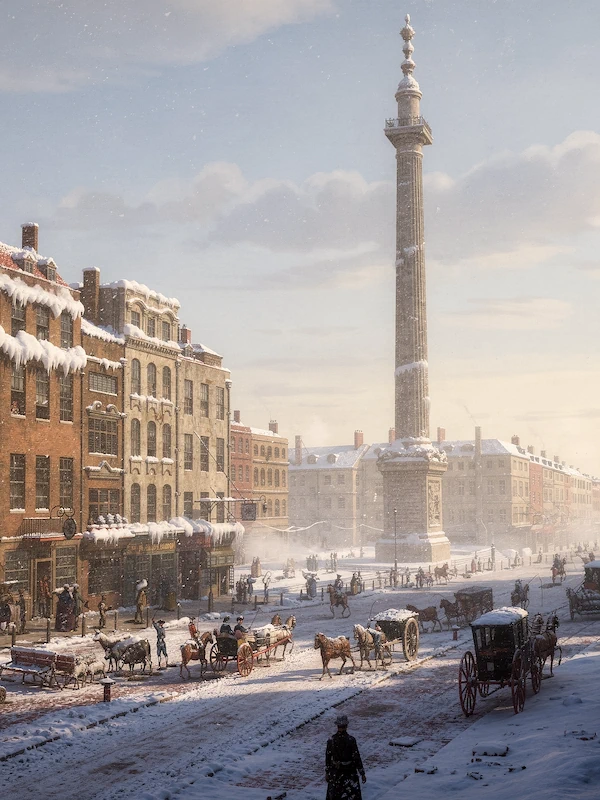
“A sightseeing tour? Seriously?” Miray pointed at the sixty-metre-high column sticking out of the ground in front of us. “What is that?”
“The Monument,” I explained. “It commemorates the Great Fire of London, which started in a bakery here in 1666 and nearly burned down the whole city.”
She looked up uneasily at the square viewing platform under a golden flame at the top. “I hope you’re not planning on dragging me up there.”
“Nah.” I waved her off defensively. “I just need you to keep a lookout.”
I pulled a knife from my pocket and flicked it open.
“Keep a lookout?”
“You’ll see.”
Then I got to work on the base of the monument while Miray stood behind me keeping an eye on the street. When I was done, I inspected my artwork: a little heart in the stone with the letters D and M inside.
Miray looked at me like I’d completely lost the plot.
“For eternity,” I explained. “Buildings come and go, but The Monument is still standing. As soon as I wake up from this dream world, the first thing I’ll do is check if the carving is still there.”
“Generations of school kids are going to wonder who the vandal was.” Miray grinned. “Let’s go. We’ve got a job to do.”
We headed back to the dock and hailed a cab. Miray asked the driver to take us to the Royal Art Gallery by the safest route.
“The safest, miss?” he repeated. “I needn’t ponder on that long. The high road leads directly there. The narrow byways would be a most unnecessary detour, they would.”
Then we set off. We took the route back the way we came. The roads got wider and busier the closer we got to our destination. It would have been absolutely impossible to break into an escorted carriage and tamper with the crate while on the move.
The curator was already waiting for us at the museum. Pritchard was a young bloke, barely older than twenty. His mouth had a friendly smile, but his eyes gave it away. The grief over the lost painting had clearly hit him hard.
“Have you managed to discover aught of importance?” he asked anxiously.
Miray shook her head. “Nothing,” she said, disappointed. “The painting was shown to the press at the warehouse, so it definitely made it to London. And there’s no way anyone broke into the carriage during transit.”
I could only see one possibility left. “It must have been nicked here in the museum.”
Pritchard shook his head. “Mr Stirling, Mr Kuiper and I fetched the crate from the carriage together and brought it inside. It was still sealed when we placed it in the exhibition hall. Mr Stirling and Mr Kuiper gave an address to a small gathering of esteemed guests. They unlocked it with great ceremony, but alas, nothing but the cloth remained within.”
“Could Bishop have hidden in the carriage?” Miray asked. “He would have had plenty of opportunity to tamper with the chest during the journey.”
“Well, pray, see for yourselves.”
Pritchard led us to the carriage parked in the museum’s courtyard and unlocked it. With a gesture, he invited us to look inside.
The carriage was obviously designed for transporting goods. The inside was empty. Just two narrow planks attached to the side walls, running from the front to the back to serve as makeshift benches. Nobody could have hidden under them.
The window panes were intact, the windows themselves locked and could only be opened from the inside. There weren’t any other doors, flaps, or openings apart from the door we were currently sticking our heads through.
“The painting can’t have gone missing here,” Miray said. “That just leaves the hall.”
“I should be honoured to escort you there,” said Pritchard.
He took us from the courtyard up a spiral staircase to where the painting was meant to hang. Everything was already prepped for it. The room was heated and festively decorated. The nicest, brightest bit of the wall had been cleared. The empty crate sat underneath it, the padlock still hanging from it. It was open but looked completely undamaged.
“Poor Mr Stirling,” Pritchard said behind us. “The painting had entirely captivated him. He even had a frame crafted to the exact dimensions and hung upon the chosen spot. Every evening he stood before it, quite forgetting the world around him as he mused upon the Vermeer. Today it was to have taken its rightful place there. And now it has vanished.”
His voice cracked a bit. The loss seemed to be really getting to him.
“It is dreadful. The painting is a unique masterpiece, quite irreplaceable. Not to mention the ruinous mark upon our reputation. It took us tremendous effort to persuade the Willemshuis to loan us the Alchemist. You simply must retrieve it!”
“We’ll do what we can,” Miray promised. “The painting can’t have just vanished into thin air.”
We’d checked the route from the docks to the designated wall without finding a single clue. There was nothing more we could do, so we said our goodbyes to Pritchard and left the museum.
It was already getting dark outside. Starving, we wandered around the city and eventually ended up in Piccadilly. The place was buzzing, the street a sea of people from all walks of life, clattering cabs, and flickering gas lamps. Down a side street, we spotted a chophouse that smelled absolutely glorious and popped in. Inside, the smell of charcoal and roast meat was even stronger.
It was the perfect spot to celebrate Miray’s birthday with steaks like I’d never had before in my life. They were massive, juicy, and still sizzling on the plate. But Miray was just picking at her food. Her mind wasn’t in this loud, warm room, but somewhere else entirely.
By the time we got back to the office, it was nighttime. Miray put the kettle on and retreated to the wingback chair.
I opted for the chaise longue, stretching out and nursing my full stomach.
“How can you lie down now?” she complained. “We haven’t achieved anything.”
“Why? It could hardly be going better, don’t you think? We had the best steaks of our lives while Scotland Yard does all the hard graft for us. Now all we have to do is wait for Leblanc to nick the thief and find the painting, and then we can wake up.”
“Don’t you think that’s a bit too easy?” She nudged the chaise longue with her foot. “What’s the point of this dream trip if there’s nothing for us to do but sit around killing time?”
I sighed. “Maybe you’re seeing problems where there aren’t any, Miray. It’s a dream. Who says it always has to have a point? Remember the fancy restaurant in Dubai? There was nothing to do there either but clear the plates they put in front of us.”
“I don’t think…” Miray started, when there was a knock at the glass door.
It was Leblanc.
I opened the door and invited him in. He shuffled slowly over to the chaise longue, sat down, and warmed his hands by the stove.
I brought him a cuppa. He took it gratefully, popped in two sugars, and stirred it absent-mindedly while we watched him eagerly.
“Bishop was a blind alley,” he finally broke the silence. “I received word but a moment ago that he was apprehended four days past, whilst attempting to relieve a villa of its jewels. He has been breathing the wholesome air of Dartmoor prison ever since.”
“Not great news,” Miray said, giving me that look that let me know I’d been wrong.
Leblanc nodded wearily. “Furthermore, it has reached the ears of the evening press that we uncovered a monogram and are seeking Bishop. Scotland Yard now looks thoroughly foolish. I should dearly like to know how those scribblers caught wind of it.”
Miray and I laughed awkwardly. I cleared my throat. “Maybe we mentioned something like that when we bumped into a reporter at the docks.”
Leblanc stared at me. “You told a journalist that we had discovered a monogram?”
“It was a trade,” I tried to justify myself. “In return, we got the intel that Stirling showed the painting to the press at the docks. So it’s definitely reached London, at least.”
“A mere glance at today’s Times would have sufficed for that.”
Leblanc rubbed his forehead. But he didn’t seem properly angry, more exhausted. He put his cup down and slapped his hands flat on the table.
“Every railway station and arterial road out of London has been sealed. My men are thoroughly questioning former convicts presently residing within the city. Whosoever has stolen the painting shall fall into our net, sooner or later.”
Then he thanked us for the tea. I showed him to the door and saw him off on the street.
“So much for ‘Scotland Yard doing the hard graft for us’.” Miray had sunk deep into the armchair. “It could take weeks or months for Leblanc to get anywhere. Maybe he won’t even find the thief. I don’t fancy sitting around here waiting for fate to take pity on us.”
I nodded. “I’ll admit you’re right. We need to do something ourselves. But what?”
I went over to the window and looked out. It was snowing again, tiny flakes dancing in the dim glow of the gas lamps. Even here in the warm, behind the glass, I could feel the freezing cold out there.
Then I had an idea. I turned around and was just about to speak when Miray immediately cut me off.
“Don’t say it,” she pleaded, “please.”
“How do you know what…”
“I bet you were just about to suggest letting the detective on Baker Street do the dirty work.”
I shrugged. “And what would be so bad about that?”
She looked at me, outraged. “Have you got no pride?”
“There’s nothing wrong with asking someone for help.”
She pointed at the bookcase. “Let’s search the newspaper archives for clues instead.”
I looked at the stack of newspapers. It wasn’t an archive, it was a complete timeline of the last ten years. At least.
“That’ll take all night,” I groaned.
“Then we’d better get started.”
We split the archive into even and odd months and searched for anything related to the case.
After a while, I found something.
“Here’s an article about Jack Bishop breaking out of Dartmoor two weeks ago. They don’t know how he managed it. Maybe he had help from one of the guards.”
Miray shook her head. “You heard Leblanc. Bishop is out, he’s got an alibi.”
“True.”
“But what do you make of this?” Miray pointed to an article in her paper. “The Royal Art Gallery had a painting nicked four years ago too. The director at the time had to resign over it, and Stirling – who was the museum’s curator back then – stepped into his shoes.”
“Maybe the same thief?”
“Possible. It probably wasn’t difficult; security was supposedly an absolute joke. As the new director, Stirling immediately made sure nothing like that would happen again.”
I gave a massive yawn.
“You can barely keep your eyes open,” Miray noticed. “Get some sleep.”
I nodded gratefully. “And you?”
“I’ll stay in my chair and keep searching.”
I snuggled into my coat and got comfortable on the chaise longue. Then I watched Miray as she tackled the next newspaper.
The crackling of the fire and the soft rustling of the paper finished me off. After a few minutes, I was fast asleep.
In my dream, I’m standing in a dark, narrow staircase in front of a door. I open it and step into a Victorian room, lit and heated by a roaring log fire. Near the fireplace is an invitingly large sofa, and opposite it, a wingback chair.
On the other side of the room is a hotel bar, modern and geometric. It looks completely out of place. Behind it stands Miray in a flawlessly white bartender’s suit.
“Good evening, Dr Hilton,” she greets me.
“Dr Hilton?” I ask, confused, and step closer.
She hands me my business card. “Yeah, Dr Dian Hilton, botanist.”
A botanist? I can’t help but think of my mum, who always says that under my care, even plastic flowers wither.
“And you are?” I ask.
“Miss Swift, obviously, the best female detective in London.”
I clear my throat. “Probably the only female detective in London, too.”
She tilts her head and looks at me, offended. Then she hands me a filled whisky glass.
“I made you a Snowball.”
I take the glass and smell it.
“This is just sherry,” I point out.
She nods. “I didn’t mean the drink.”
And then she lobs a snowball right into my face. The snow is wet and cold. I try to wipe it off, but it sticks to my skin like chewing gum.
Something shook me.
“Get up, Dian,” I heard Miray’s soft voice.
My face still felt wet and cold. I blinked and saw her sitting next to me on the edge of the chaise longue. The bags under her eyes gave away that I was probably the only one who had managed to get any sleep that night.
Then I noticed she was holding snow in her hand.
“Seriously? Did you just rub snow in my face?” I asked indignantly.
She completely ignored it and brushed the stuff off her hands.
“Did you know the post here is delivered up to twelve times a day? You can send a letter in the morning and have a reply by the afternoon.”
I rubbed the sleep from my eyes. “You mean like a Victorian text message?”
“Yeah. I wrote Stirling a letter saying we’ll have returned the painting to its rightful owner by tonight.”
“Wasn’t that a bit too optimistic? When I fell asleep, we didn’t even have a lead.”
“We need to get going.” She handed me my shoes. “We’ve got an eight o’clock appointment with Leblanc at the docks.”
“And what are we doing there?”
With a massive grin, she pointed to a little jewellery box sitting on her desk.
“I’m going to do some magic.”
Leblanc was already waiting by the warehouse when we arrived. He was visibly shivering and looked at Miray grumpily as she walked up to him.
“Miss Miray,” he said with a raspy voice, “I have been toiling over this case half the night and found no slumber. For this rendezvous, I was compelled to forgo breaking my fast with my dear wife. I do sincerely hope this endeavour proves worthwhile.”
“It will, Mr Leblanc.” She nodded slowly. “I’m sure it will.”
She placed the jewellery box on the crates next to the warehouse, unlocked it, flipped the lid open, and pulled out a grey linen cloth.
“May I have your pocket watch, Mr Leblanc?” she asked, holding out her hand.
The inspector eyed Miray suspiciously. Then he pulled his watch from his pocket and handed it to her hesitantly.
“‘Tis an heirloom from my grandfather. Whatever you intend to do with it, I shall require it back in the end. And perfectly intact, I say.”
“Nothing will happen to your watch,” Miray promised, starting to wrap it carefully in the cloth. “That is, if I don’t mess up.”
Then she showed us the result. The shape of the watch was clearly visible under the linen.
She gently placed the cloth into the little box. Then she closed the lid and turned the key.
She handed the box over to a bewildered Leblanc. “Look after it carefully if you want your watch back.”
She gave me the key. “That’s for you, Dian. And don’t let it out of your sight for a second.”
Leblanc grunted briefly. He pulled at the lid, but it was locked tight.
“Now what?” I asked.
“Now?” Miray pointed to a pub just across the street. “None of us have had breakfast yet, right?”
The pub door creaked softly as we opened it. The room inside was basic but clean. The walls were wood-panelled up to waist height, whitewashed above. A bit of sparse daylight filtered through the windows, almost making it look like the place was still closed. The smell of scrambled eggs and fried bacon gave it away, though.
Leblanc breathed into his hands and rubbed them together. He spotted a table near a stove and headed straight for it. We followed and sat down. He plonked the box onto the table where he could keep a good eye on it.
The landlord came over, a scrawny bloke with a moustache, and looked at us expectantly.
“Eggs and bacon. And a brandy,” Leblanc said gruffly. “To ward off the chill,” he added, almost apologetically.
The landlord cleared his throat. “This establishment is a Temperance Bar, good sir. We serve no intoxicating spirits here.”
Leblanc let out a short laugh. “A Temperance Bar upon the docks? Do you truly believe that to be a prudent notion?”
Then he ordered tea. We followed up with a hearty breakfast and coffees.
“Any news?” I asked Leblanc while we waited for the grub.
He twisted his mouth. “Not exceedingly much. Our usual suspects are clean thus far, possessing either alibis or other tribulations of their own. A few Londoners provided tips, which we pursued, alas to no avail. One gentleman brought us a painting – a most transparent forgery – and demanded a recompense.”
He shifted nervously on his chair, then looked at Miray. “Wherefore have you summoned me hither?” he asked brusquely. “I should hope it was not merely for this parlour legerdemain.”
“I will explain it to you in a moment,” she replied. “Let’s have breakfast first.”
Right on cue, the landlord came out of the kitchen and set down three generously loaded plates for us.
After we had eaten and Miray began talking about the weather, Leblanc grew impatient. Absent-mindedly, he reached for his watch, but could not find it. Startled, he patted down his coat pockets. Then his eyes fell on the little box.
“When do you intend to return my timepiece?” he grumbled.
Miray nodded. “I think I’ve kept you waiting long enough. Dian, got the key?”
I reached into my coat pocket, pulled out the key and handed it to Leblanc.
He pulled the box towards him, unlocked it and opened the lid. Then he reached inside, pulled out the cloth and laid it on the table in front of him. He unfolded it slowly, as if terrified of damaging the delicate item inside.
His hand froze. The colour drained from his face.
The cloth was empty.
“This cannot be,” he cried in alarm. He looked into the box, lifted it, turned it upside down. But there was nothing left inside.
He stared at Miray in absolute horror. “How is this possible? The casket was locked tight, I verified it myself. I had it upon my person the entire time, betwixt my hands or before my very eyes.”
“And the cloth?” she asked.
He held it up. In one corner was a monogram, an embroidered JB.
“Bishop!” Leblanc shouted, gob-smacked. “This is utterly preposterous.”
“It is. Tell me what you saw.”
“Well… you took my watch, swathed it in the cloth. Then you presented it to me once more, ere placing it into the casket and turning the key.”
“Almost right.”
With a massive grin, she reached into her coat pocket, pulled out a cloth and unwrapped it. Inside was Leblanc’s pocket watch. He picked it up, inspected it from all angles, as if he couldn’t quite believe it was actually his.
“But my watch was wrapped in the cloth, I saw it myself. Unless…”
Leblanc suddenly beamed, as if he’d had a revelation.
“I comprehend… You swapped the timepiece with another, prior to placing it in the casket. A clever parlour trick, Miss Maskelyne, but pray tell, why did I not find the other watch?”
“There is no other watch. I set everything up in the night. I placed a cloth in the box. Onto a second cloth, I embroidered the monogram. Then I dampened it, wrapped it around my pocket watch and placed it outside in the snow. After a while it was frozen stiff and had taken on the shape of the watch. It took me several attempts before I managed to get my watch out and close the final folds so that it looked convincing. For the rest of the morning I kept the prepared cloth with me, always making sure that it did not thaw.”
She moved her hands like a magician.
“I showed you your watch, wrapped it in the cloth from the box, but then I secretly swapped it for the frozen duplicate. You thought you were seeing your watch, but what I actually put in the chest was the second cloth with the monogram. An empty shell in the shape of a watch, nothing more.”
Now I got how the trick worked. “Over here by the stove, the cloth thawed out, collapsed and dried. And just like that, it looked like the watch had vanished.”
Leblanc’s mouth was hanging open.
“But that means…” he started.
Miray nodded. “Stirling. Spot on. He had a similar frame made, just like the curator told us. But not to find a suitable spot for the painting. He needed it to make a frozen cloth with a similar outline. Then he performed the exact same trick outside the warehouse in front of the gathered press and swapped the painting. Didn’t you find it weird that he chose to present such a valuable painting outside on a freezing winter’s day of all days?”
His fist slammed onto the table. “Mr Stirling stated that the warehouse was too dim for the press. It struck me as rather peculiar straightaway.”
“Your instincts were right. Inside the warm warehouse, the prepared cloth would have thawed too early and given his trick away. It only thawed back at the museum while Stirling was giving his speech.”
“But where is the painting? We searched everywhere thoroughly, the carriage, even the garments. Mr Stirling insisted upon it. Yet we found nothing.”
Miray jerked her thumb over her shoulder towards the warehouse. “There’s only one possibility: he hid it here.”
Leblanc jumped up. “We must search the premises, forthwith!”
“Or,” Miray said calmly, “we wait until Stirling brings it to us himself.”
I hesitated. Then it dawned on me. “Your letter to him!”
She grinned. “Exactly. My message saying we’ve found the painting by tonight should have him properly panicking. All we need to do now is wait and have a cup of tea.”
So we waited. The hours ticked by. Eventually, it turned into the afternoon.
We were still watching the warehouse from the pub. The docks were bustling with activity, but there was no sign of Stirling.
We were just about to give up when an older gent came hobbling along the quay. In front of the warehouse, he glanced around. He looked like a typical dock worker, wearing tattered clothes and a flat cap. His face was filthy and covered in soot, his full beard mucky. Once he was sure nobody was following him, he went inside.
Leblanc looked almost disappointed. “Blackened face, cap pulled low, a counterfeit beard… What a truly wretched disguise. Well then, let us apprehend Mr Stirling.”
We left the pub and positioned ourselves next to the warehouse gate. We waited there, but nothing moved.
Then a side door at the far end opened. Stirling slipped out. He was still wearing his disguise, but now he had a bag tucked under his arm.
“Halt!” Leblanc bellowed. “Stand your ground! Scotland Yard!”
Stirling jumped. Then he hugged the bag tightly to his chest and bolted.
“Forget it,” Miray said. “Not on my watch.”
She shot off after him like a greyhound.
Leblanc threw his arms up. “Remain where you are, that is far too perilous!”
I nodded slowly. “Yeah,” I muttered. “Stirling must be mental.”
“Stirling?” Leblanc stared at me in disbelief. “Why Stirling? I spoke of Miss Miray!”
I couldn’t hold back a massive grin.
Stirling ran as fast as he could, but Miray was quicker. She grabbed him by the shoulder, caught his arm, and twisted it behind his back. He cried out and froze on the spot.
Then he let Miray march him over to us.
“Here’s our culprit,” Miray said proudly. “And the Vermeer is definitely in the bag.”
Leblanc opened it and pulled out a painting. It really was the Alchemist.
“Thus ends your career as director, Mr Stirling,” Leblanc proclaimed. “Your preposterous disguise could not deceive us.”
Miray cleared her throat. “It’s not Mr Stirling.”
She pulled the man’s flat cap down. And she was right. The bloke had blackened his face. The filthy, full beard, however, was real.
We recognised him instantly.
“Mr Kuiper!” Leblanc cried in astonishment. “It makes no sense whatsoever!”
“On the contrary, it finally makes sense,” Miray countered. “Mr Stirling wouldn’t have received a penny from the insurance through the theft, but rather the Willemshuis, and with it Mr Kuiper.”
She turned to her prisoner.
“You teamed up, didn’t you? Stirling staged everything perfectly. The press call to prove the painting arrived in London. The escorted transport meant to deflect any suspicion from you. The speech at the museum, during which the cloth thawed. He swapped the painting here at the warehouse. And while the press were watching him carry the crate to the carriage, you took the opportunity to hide the painting.”
“Lelijk kreng!” hissed Kuiper, spitting at Miray’s feet.
Miray twisted his arm another centimetre. Kuiper gasped, his knees buckling.
Then she continued. “Stirling learned from the press that Jack Bishop had escaped. That suited him perfectly. He embroidered the monogram onto the cloth to lay a false trail and buy time. He would almost have succeeded, had Bishop not been caught again.”
“But pray, what was Stirling’s motive?” asked Leblanc. “He stood to gain nothing.”
“He wanted the painting. When he was still a curator at the Royal Art Gallery, a picture went missing. Back then, they blamed it on inadequate security and sacked the former director. I’m positive that if you turn his rooms upside down, you’ll find a nice little private collection that was about to get a Vermeer richer.”
Leblanc had meanwhile fished some handcuffs out of his coat and slapped them on Kuiper. He hauled him forward, heading for Scotland Yard.
After a few steps, he suddenly stopped and turned back to us.
“Miss Miray, Mr Dian,” he said, “should you ever choose to relinquish your detective agency, I implore you to call upon me. Scotland Yard is ever in need of capable investigators such as yourselves.”
Then he gave Kuiper a hard shove, and they vanished around the next corner.
The green circle had long since appeared on our wrists, and yet we were still drawn back to our office for a while. Miray sank into her wingback chair, I stretched out on the chaise longue. Just like always.
“So your real self is in London too?” Miray asked.
I nodded. “Probably getting a sunburn on a park bench right about now.”
She looked at me in silence for a while.
“I still think this is all just imagination,” she said eventually. “But next time, you’ll have to tell me if your scribble was still on the Monument.”
The little bell above the door rang, making us both jump.
Wellington stepped in. He looked relieved.
“I have just returned from Scotland Yard,” he said. “Thanks to your endeavours, the painting is recovered, and wholly intact. The Lancaster & Wellington Insurance Company is deeply in your debt.”
Miray smirked. “You’ll see just how deep when you get the bill.”
He paused for a moment, then nodded. “Mr Leblanc has had the premises of the museum thoroughly searched. They discovered a wardrobe in the cellar that concealed a door. Behind it lay a small chamber filled with paintings and sculptures, all of them purloined.”
“Bet Mr Stirling wasn’t too thrilled about that,” Miray remarked.
Wellington smiled. It was the first time I’d seen him smile. “I can assure you, Miss Miray, he was most irate when Mr Leblanc clapped him in irons and marched him away.”
An appreciative nod.
“My secretary was not mistaken in her judgement of you. I assure you: should we ever require the services of a detective again, my path shall lead directly to your door.”
He put on his top hat, tapped his cane on the floor once, bid us farewell, and left.
“Another happy client,” I commented, once the door had shut behind him.
Miray nodded. “It’s almost a shame we have to leave this place. I was just getting used to having my own detective agency. But let’s not drag it out any longer, Dian. I bet you’re dying to go find out what happened to your engraving.”
She opened her arms wide and gave me a tight hug. Our eyes met.
“Until the next adventure, Dian.”
“Yeah, until the next adventure.”
Then we touched our tattoos.
Two dogs growled loudly, waking me from my sleep. I looked around. St James’s Park, the park bench. In front of me, a pitbull and a mastiff barking at each other, their owners behind them desperately tugging at the leads.
I was back.
I had to get my bearings for a second. I grabbed my smartphone. It was too far to walk from the park to the Monument, but the famous Tube would get me there in just a few minutes.
Shortly after, I was standing in front of the memorial. The area had changed massively. In the dream world, there was a large square and wide streets here. Now everything was cramped, built up, with office blocks jutting out of the ground.
The Monument itself, however, had barely changed. The weather had chipped away at the stones a bit, and yet, over a century later, it still looked just as imposing as it did when I was here with Miray.
I knew exactly which stone I’d scratched my message into. The spot was near the bottom, somewhat hidden and easy to miss if you didn’t know where to look.
I was sure. Absolutely sure.
And yet, the stone was untouched. My engraving wasn’t there. It had never been there.
“So it was just a dream after all,” I groaned quietly, rubbing the back of my head.
Then I couldn’t help but grin. Either that, or my little piece of art exists in Miray’s present instead.